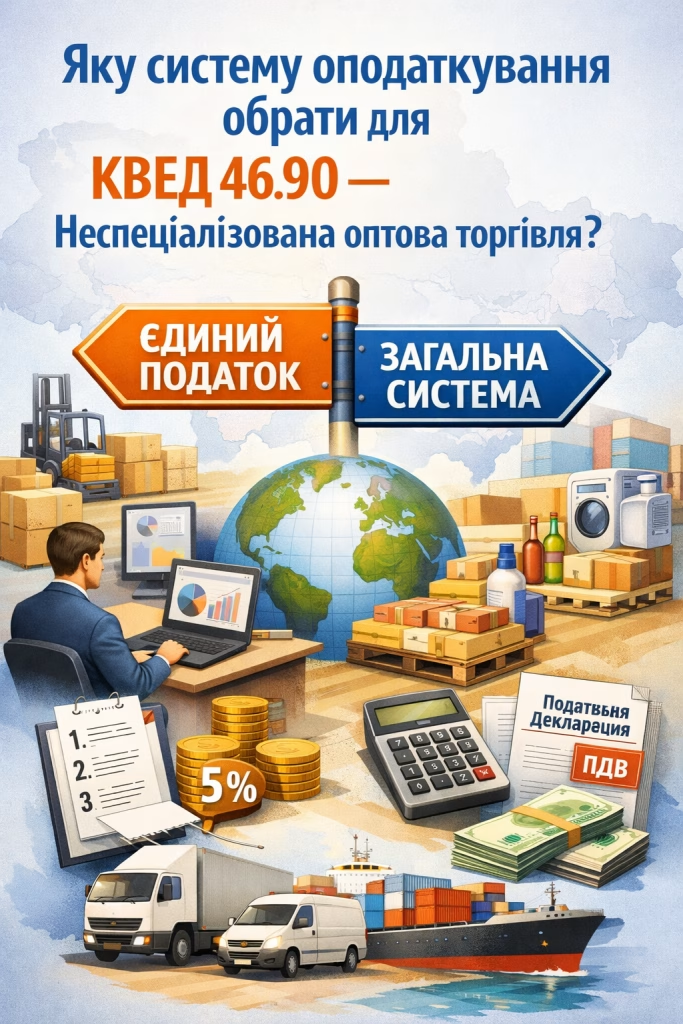
Non-specialized wholesale trade (NACE code 46.90) — one of the most common types of activity for individual entrepreneurs and companies that work with different groups of goods and large sales volumes. That is why the issue of choosing a taxation system is key even at the stage of registering a business or planning its scaling.
An incorrectly chosen taxation system can lead to an excessive tax burden, VAT problems, fines, or restrictions on working with counterparties. In this article, we will consider, What taxation system should be chosen for KVED 46.90?, what are the differences between the simplified and general systems, when it is advisable to work on a single tax, and when to switch to VAT or the general system.
The material will be useful Sole proprietorship and LLC, who are engaged or plan to engage in wholesale trade in Ukraine and want to make a well-considered tax decision without unnecessary risks.
What is non-specialized wholesale trade (KVED 46.90)
Concept and definition of KVED 46.90
Non-specialized wholesale trade is a type of economic activity that involves the wholesale sale of a wide range of goods without a clear product specialization. Code KVED 46.90 used in cases where the company sells different groups of goods and does not focus on one specific product category.
This type of activity is typical for businesses with a dynamic assortment or those that work with several product lines simultaneously.
What goods does KVED 46.90 cover?
KVED 46.90 allows wholesale trade in most goods, with the exception of certain licensed or specially regulated categories. Most often, this type of activity sells household and household goods, building materials, industrial products, packaging materials, stationery and office supplies.
If the activity is focused exclusively on one product group, it is more appropriate to use a specialized wholesale trade code.
Who usually uses KVED 46.90
KVED 46.90 is most often chosen by individual entrepreneurs and LLCs that operate in the B2B format, are engaged in distribution, trade brokerage, or import of goods with subsequent wholesale resale. This code is suitable for businesses that plan to expand their range and do not want to limit themselves to a narrow specialization.
How does KVED 46.90 differ from specialized wholesale trade?
The main difference between non-specialized wholesale trade is its versatility. Specialized KVEDs involve trade in a specific category of goods, while KVED 46.90 allows you to work with different groups of goods at the same time. It is this flexibility that makes it popular, but at the same time requires a careful approach to choosing a taxation system and accounting.
What taxation systems are available for KVED 46.90 in Ukraine?
General taxation system
The general taxation system is available to both sole proprietors and LLCs and has no restrictions on income, number of counterparties, or product range. For non-specialized wholesale trade, this system is often used in cases of large turnover, import work, or complex supply chains.
Under the general taxation system, an individual entrepreneur pays tax on net profit, i.e. the difference between income and documented expenses. For an LLC, corporate income tax applies. In most cases, wholesale trade under the general system involves registration as a VAT payer.
Simplified taxation system (single tax)
The simplified taxation system is the most popular among entrepreneurs working with KVED 46.90, but it has certain limitations. Not all groups of the single tax are available for wholesale trade, so the choice must be made taking into account the specifics of the activity.
The simplified system allows you to reduce the tax burden and simplify accounting, but requires control over income limits and the status of counterparties.
Self-employed persons in the second group: opportunities and limitations
The second group of the single tax formally allows for trade, but it is rarely suitable for non-specialized wholesale trade. The main limitation is that an individual entrepreneur of the second group can only work with the population and single tax payers, which actually makes full-fledged B2B wholesale activities impossible.
That is why using the second group for KVED 46.90 often leads to violations and tax risks.
Individual entrepreneur in the third group: the most common option
The third group of the single tax is the most universal and safest option for non-specialized wholesale trade. It allows you to work with any counterparties, including legal entities and VAT payers.
An individual entrepreneur can choose a single tax rate without VAT or with VAT, depending on the business model and customer requirements. It is the third group that is most often used for wholesale trade with a wide range of goods.
Can an LLC operate on a simplified system?
An LLC can also apply a simplified taxation system, provided that the criteria established by law are met. For non-specialized wholesale trade, this can be beneficial at the start of the business or with average turnover.
At the same time, in the event of an increase in income, the need to refund VAT, or work with large chains, LLCs often switch to the general taxation system.
Simplified taxation system: is it suitable for wholesale trade (KVED 46.90)
When a simplified system is appropriate for wholesale trade
The simplified taxation system can be beneficial for non-specialized wholesale trade, provided that the business has a relatively simple structure, controllable revenue, and a clear model of working with counterparties. It is most often chosen at the start of operations or in cases where the company operates without complex cost chains.
For KVED 46.90, the simplified system allows you to reduce the tax burden and simplify accounting, but requires careful compliance with income limits and legislative requirements.
Individual entrepreneur group 2: why it is almost not suitable for KVED 46.90
An individual entrepreneur in the second group of the single tax has significant restrictions on the range of counterparties. Such an entrepreneur can provide services and sell goods mainly to the population or other single tax payers. For wholesale trade, which is usually focused on legal entities, this creates serious restrictions.
The use of the second group for non-specialized wholesale trade often leads to situations where actual activities do not meet the requirements of tax legislation, which may be grounds for fines or a forced transition to another taxation system.
Individual entrepreneur group 3 without VAT: who is it suitable for?
The third group of single tax without VAT is a popular option for individual entrepreneurs who engage in wholesale trade with relatively low costs and work with clients who do not consider VAT tax credit as a principle. The entrepreneur pays a single tax on all income received, regardless of the level of expenses.
This format is convenient for businesses with high margins, but may be disadvantageous in the case of large purchases or imports of goods.
Individual entrepreneur group 3 with VAT: the best option for B2B
For most entrepreneurs engaged in non-specialized wholesale trade, the third VAT group is the most balanced solution. It allows you to work with large customers, VAT payers, and generate a tax credit.
This option is suitable for businesses with large volumes of purchases, importing goods, or cooperating with network companies. At the same time, it requires more complex accounting and discipline in reporting.
Limitations and risks of the simplified system for wholesale trade
The main risks of the simplified system for KVED 46.90 are exceeding income limits, incorrect selection of the single tax group, and ignoring VAT requirements. It is also important to consider that the simplified system cannot take into account expenses when calculating tax, which can be critical for a wholesale business with low margins.
That is why, before choosing a simplified system, it is worth analyzing the financial model of the business and its development prospects.
General taxation system for KVED 46.90
When a common system is appropriate
The general taxation system is appropriate for non-specialized wholesale trade in cases where the business has large turnover, significant expenses, or operates with complex supply chains. It is most often chosen by companies that import goods, cooperate with large corporate clients, or have low margins.
For KVED 46.90, the general system allows you to legally optimize the tax burden by taking into account expenses and avoid restrictions typical of the simplified system.
Taxes for sole proprietors on the general system
An individual entrepreneur under the general taxation system pays taxes on net profit, i.e. on the difference between income received and documented expenses. The main taxes include personal income tax and military levy, as well as a single social contribution.
This approach is beneficial for wholesale trade with large purchases, as it allows you to reduce taxable profit due to the costs of purchasing goods, logistics, and storage.
Taxes for LLCs on the general system
LLCs on the general system pay corporate income tax, which is calculated from the financial results of their activities. Accounting is carried out according to accounting rules, which requires greater discipline and professional support.
For non-specialized wholesale trade, such a system is often standard, especially when working with large volumes of goods and VAT payers.
VAT on the general taxation system
In most cases, wholesale trade on the general system involves VAT registration. This allows you to generate tax credits, work with large contractors, and participate in tenders.
At the same time, VAT significantly complicates accounting and requires timely maintenance of primary documents and tax reporting.
Advantages and disadvantages of the general system for KVED 46.90
The main advantage of the general system is the ability to take into account expenses and the absence of restrictions on income and counterparties. This makes it convenient for large-scale wholesale businesses.
Among the disadvantages, it is worth highlighting more complex accounting, increased tax burden in the absence of expenses, and the need for professional accounting support.
VAT on non-specialized wholesale trade (KVED 46.90)
When VAT registration is mandatory
For entrepreneurs engaged in non-specialized wholesale trade, the issue of VAT often arises in the first months of operation. Registration as a VAT payer becomes mandatory if the volume of taxable transactions established by law is exceeded during a certain period. For wholesale trade, where turnover is usually significant, this threshold is reached quite quickly.
In this case, the entrepreneur or company is required to register as a VAT payer, regardless of the chosen taxation system.
Voluntary VAT registration: when is it beneficial?
Voluntary VAT registration may be appropriate before reaching the mandatory threshold. This is most often the case for businesses that work with VAT-paying customers, import goods, or have significant VAT purchases.
For KVED 46.90, voluntary VAT registration allows you to generate a tax credit and increases trust from large counterparties, especially in the B2B segment.
Advantages of VAT for wholesale trade
The main advantage of VAT for non-specialized wholesale trade is the ability to reduce the tax burden through tax credits. This is especially important for businesses with large purchasing volumes, imports, or complex logistics.
In addition, VAT payer status expands opportunities for cooperation with large companies, chains, and participation in tenders.
Disadvantages and difficulties of working with VAT
VAT significantly complicates tax and accounting. An entrepreneur must keep detailed records of tax invoices, register them in a timely manner, and submit reports. Errors or delays can lead to fines and blocking of tax invoices.
For a small business or sole proprietorship with a small staff, this can be an additional financial and administrative burden.
VAT and counterparties: what to pay attention to
In non-specialized wholesale trade, it is important to consider the status of counterparties. If the main customers are VAT payers, the lack of this status can be a competitive disadvantage. At the same time, if customers are not interested in a tax credit, working without VAT can be simpler and more profitable.
It is the analysis of counterparties that is one of the key factors when making a decision about registering as a VAT payer.
Comparative characteristics of taxation systems for KVED 46.90
Individual entrepreneur group 2
An individual entrepreneur in the second group of the single tax can formally carry out trading activities, but for non-specialized wholesale trade this option is almost never used in practice. The main reason is the limited range of counterparties, since working with legal entities in the general system or large companies is actually prohibited.
This option is only possible in exceptional cases and is not suitable for classic B2B wholesale.
Individual entrepreneur group 3 without VAT
A sole proprietorship in the third group without VAT is a simple and clear option for entrepreneurs who have relatively small expenses and work with clients who do not care about tax credits. Tax is paid on all income received, which simplifies accounting, but does not allow for taking expenses into account.
For wholesale trade with high margins, this option may be profitable, however, with large purchases or imports of goods, the tax burden increases.
Individual entrepreneur group 3 with VAT
A sole proprietorship in the third VAT group is the most versatile solution for non-specialized wholesale trade. This format allows you to work with any counterparties, generate tax credits, and scale your business without changing the taxation system.
At the same time, it requires more complex accounting and strict control over tax reporting, which often requires the involvement of an accountant.
General taxation system
The general system is the best option for businesses with large turnovers, significant expenses, or low margins. It allows you to take into account all documented expenses and has no restrictions on income and counterparties.
For KVED 46.90, the general system is often used by LLCs or sole proprietors who work with imports, large suppliers, and corporate clients.
Which system to choose: a quick summary
For most entrepreneurs engaged in non-specialized wholesale trade, the optimal starting option is a sole proprietorship group 3 with or without VAT - depending on the clients and cost structure. The general system is advisable in cases of large-scale business or a complex financial model.
The correct choice of taxation system for KVED 46.90 should be based not only on current indicators, but also on business development plans.
Typical mistakes when choosing a taxation system for KVED 46.90
Incorrect choice of single tax group
One of the most common mistakes is choosing the second group of the single tax for non-specialized wholesale trade. Due to restrictions on counterparties, this model does not correspond to the real conditions of the wholesale business and creates a risk of tax violations.
Often, entrepreneurs focus only on a lower tax burden, without taking into account the legal requirements for actual activities.
Ignoring VAT at the start of a business
Another common mistake is starting wholesale trade without analyzing the need for VAT. For KVED 46.90, turnover can grow very quickly, and exceeding the established threshold without timely registration by the VAT payer leads to fines and additional charges.
In addition, the absence of VAT may limit cooperation with large clients and networks.
Failure to consider cost structure
Under the simplified system, tax is paid on all income, regardless of the level of expenses. If the entrepreneur does not take into account the actual margin of the business, the tax burden may be significantly higher than under the general system.
This is especially true for wholesale trade with large purchases and logistics costs.
Exceeding income limits
Insufficient control over income volumes under the simplified system often leads to exceeding limits, which entails a mandatory transition to another taxation system, fines, and tax risks.
For KVED 46.90, where turnover can be significant, this risk is particularly relevant.
Lack of professional tax planning
Many entrepreneurs make decisions about the taxation system on their own, without analyzing the financial model of the business and consulting with specialists. This leads to choosing an inefficient system that complicates the development of the business in the future.
Competent tax planning at the start allows you to avoid most typical mistakes and save significant money.
How to choose the optimal taxation system for KVED 46.90: a step-by-step algorithm
Step 1. Define your business model
First of all, it is necessary to clearly understand how the business works: who are the main customers, what sales volumes are planned, and whether work in the B2B format is envisaged. For non-specialized wholesale trade, these factors are crucial, because the possibility of using the simplified system and the expediency of registering as a VAT payer depend on them.
Step 2. Estimate your planned revenue
The next stage is the analysis of the projected income. If the expected turnover is approaching the established limits for the simplified system, it is worth immediately considering the third VAT group or the general taxation system. For KVED 46.90, exceeding the limits is quite common, so this aspect should not be underestimated.
Step 3. Analyze the cost structure
For wholesalers, expenses often make up a significant portion of revenue. Purchasing goods, logistics, storage, customs duties — all of these affect the actual profitability of the business. If expenses are significant, the general taxation system may be more beneficial than the simplified one.
Step 4. Determine the need for VAT
Decisions on VAT should be made taking into account the status of counterparties and the nature of purchases. If customers are VAT payers or the business is related to imports, VAT registration becomes practically necessary. For KVED 46.90 this is often a determining factor when choosing a taxation system.
Step 5. Assess business development prospects
The choice of taxation system should take into account not only the current state, but also growth plans. Scaling the business, expanding the range or entering new markets may require switching to a different taxation system. Therefore, it is important to immediately choose an option that will not limit development.
Step 6. Seek professional advice
The final step should be to consult with an accountant or tax consultant. A specialist will help analyze the financial model, take into account all tax risks, and choose the optimal taxation system for your business with KVED 46.90.
Conclusions and recommendations
Non-specialized wholesale trade under KVED 46.90 has its own tax characteristics, so there is no universal solution for the taxation system. For small and medium-sized businesses, the third group of the single tax with or without VAT is often the best option - depending on the cost structure and requirements of counterparties. For businesses with large turnover, imports or low margins, it is advisable to consider the general taxation system.
The right choice of taxation system should be based on an analysis of the financial model, planned revenue volumes, the role of VAT and business development prospects. Mistakes at the start can lead to unnecessary tax burden, fines and restrictions in working with clients.
That is why before making a final decision, it is worth consulting with specialists, in particular: auditing company, which will help assess risks, choose the optimal taxation system, and ensure tax security for business at all stages of its development.